
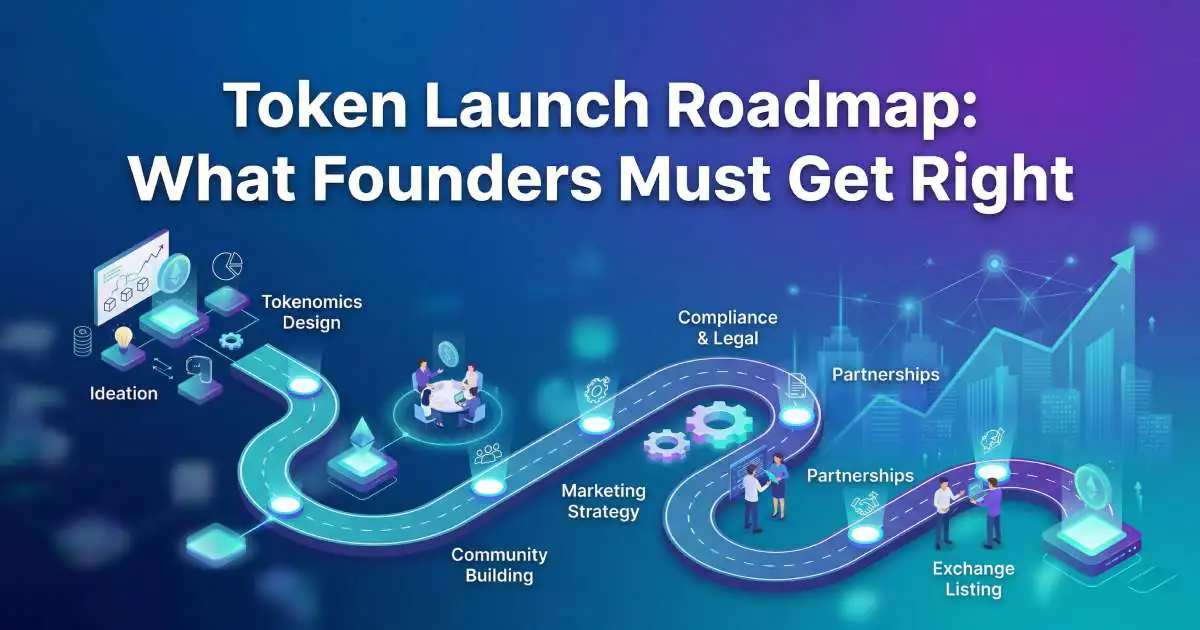
Launching a token in 2026 looks very different from what it did just a few years ago. Markets have matured, users have become more selective, and regulators are watching more closely. A token launch now sits at the intersection of product design, compliance, market psychology, and long-term ecosystem planning. Founders who treat it as a one-time fundraising event often struggle to maintain momentum after launch. Those who approach it as a structured rollout tied to real usage tend to build something that lasts.
A strong token launch roadmap is not about ticking boxes. It is about sequencing decisions in the right order so that each stage reinforces the next. From defining utility to building liquidity and sustaining post-launch activity, every step carries weight. This guide breaks down what founders must get right, focusing on the phases that actually influence long-term success rather than surface-level launch tactics.
Understanding the Purpose Before the Token Exists
Many token projects begin with the question of supply, pricing, or exchange listings. That is often the wrong starting point. The more useful question is simpler: what role does the token play inside the product?
A token should not exist as an isolated financial instrument. It should support specific actions within a system. That could mean enabling transactions, rewarding participation, granting access to services, or coordinating governance. The clearer this role becomes, the easier it is to design everything else around it.
In practice, this means mapping user behavior first. For example, a DeFi lending platform may require a token for staking, fee discounts, and governance participation. A gaming ecosystem may tie tokens to in-game rewards, upgrades, and marketplace transactions. The connection between user action and token demand must feel natural. When it does not, the token becomes dependent on speculation instead of usage.
This early clarity also shapes how the project communicates its value. Investors and users tend to respond better when they can quickly understand what the token does without needing deep technical context.
Designing Token Utility That Holds Over Time
Utility often gets mentioned, but not always implemented with depth. A token can list multiple use cases on paper while still relying heavily on trading activity in reality. The difference lies in whether those use cases create repeated interaction.
A well-designed token supports actions that users perform regularly. That repetition creates consistent demand, which stabilizes the ecosystem beyond short-term hype. Stablecoin usage offers a clear reference point. Transaction volume continues to grow because the underlying use case, moving value, happens frequently.
For founders, this translates into a few key design considerations:
- The token should be required for at least one core function inside the platform
- That function should be tied to ongoing user activity rather than one-time actions
- The value exchange should feel necessary, not optional
It is also important to avoid overloading the token with too many roles. When everything depends on the same asset, the system can become fragile. Focused utility tends to perform better than broad but shallow use cases.
Structuring Tokenomics Around Real Behavior
Tokenomics is where many projects either gain credibility or lose it. It is not just about percentages or supply distribution. It reflects how value moves through the ecosystem over time.
A practical tokenomics model aligns with three layers: distribution, incentives, and circulation. Each layer should connect back to user behavior rather than abstract assumptions.
Distribution determines who receives tokens and when. Vesting schedules, allocation splits, and release timelines influence market dynamics more than initial pricing. Sudden unlocks without matching demand often lead to sell pressure.
Incentives shape how participants interact with the system. Staking rewards, liquidity incentives, and ecosystem grants should encourage actions that benefit the platform, not just short-term engagement.
Circulation defines how tokens move once they are in the market. Mechanisms such as buybacks, fee redistribution, or burn models can influence supply dynamics, but they need to be backed by real economic activity.
A common mistake is designing tokenomics in isolation. Instead, it should be treated as an extension of the product’s business model. Revenue flows, user growth, and platform activity should all feed into how tokens are distributed and used.
Building the Legal and Compliance Foundation Early
Regulation is no longer something that can be addressed after launch. Different jurisdictions now have clearer frameworks, and ignoring them can limit access to markets or create long-term risks.
Founders need to define the legal positioning of their token early. Is it a utility token, a governance asset, or something that may fall under securities classification in certain regions? The answer influences everything from marketing language to investor onboarding.
Compliance considerations often include:
- KYC and AML integration for token sales
- Geo-restrictions based on jurisdictional requirements
- Clear communication around token utility and risk factors
- Coordination with legal advisors for documentation and disclosures
Markets like the EU under MiCA and evolving frameworks in regions such as the US and Asia have introduced more structure. This does not necessarily block innovation, but it does require a more disciplined approach.
Projects that align with compliance early tend to build stronger trust. That trust becomes a differentiator, especially when users are more cautious about where they allocate capital.
Preparing the Product Before the Launch Narrative
A token launch should not carry the weight of proving the entire product. By the time the token is introduced, users should already see signs of functionality, even if the platform is still evolving.
This does not mean the product must be fully complete. However, there should be enough substance to demonstrate that the token connects to something real. Early versions, testnets, beta releases, or limited-access platforms can all serve this purpose.
The absence of a working product creates a gap between expectation and reality. Marketing may attract attention, but without a clear product layer, that attention often fades quickly.
Founders should focus on aligning three elements before launch:
- A functional core product or prototype
- A defined user journey that integrates the token
- Clear documentation explaining how the system works
When these elements are in place, the token becomes part of an existing narrative rather than the entire story.
Building Community With Intent, Not Noise
Community building remains one of the most discussed aspects of token launches. Yet the approach has shifted. Large follower counts and high message volume do not carry the same weight they once did.
What matters now is the quality of engagement. A smaller but active community often contributes more to long-term growth than a large passive audience. Users who understand the project, ask questions, and participate in discussions tend to stay beyond the initial launch phase.
Effective community building focuses on:
- Consistent communication across platforms like Telegram, Discord, and X
- Transparent updates about progress, challenges, and milestones
- Interactive sessions such as AMAs, discussions, and feedback loops
It is also important to avoid over-promising. Communities respond better to realistic timelines and clear explanations than to aggressive hype. Trust builds gradually, and once it is established, it supports every stage of the roadmap.
Planning Pre-Launch Marketing With Clear Objectives
Pre-launch marketing sets the tone for how the project is perceived. It is not just about visibility. It is about attracting the right audience and preparing them for what comes next.
A structured pre-launch phase typically includes awareness, education, and engagement. Each stage serves a different purpose.
Awareness introduces the project to a broader audience through PR, content marketing, and partnerships. Education explains the product, token utility, and roadmap in a way that reduces confusion. Engagement creates interaction through community activities, campaigns, and discussions.
Timing plays a critical role here. Campaigns that start too late often struggle to build momentum. Those that begin early but lack consistency can lose attention. A well-planned timeline ensures that interest builds gradually rather than peaking too soon.
Working with a token development company or marketing partner can help coordinate these efforts, especially when multiple channels are involved. The goal is not just to create noise, but to guide potential users through a clear journey leading up to the launch.
Structuring the Token Sale and Launch Mechanics
Once the groundwork is in place, the actual token sale becomes a critical execution phase. This is where planning meets real market behavior. The structure of the sale influences not only how funds are raised but also how the token performs immediately after launch.
A token sale should feel controlled, not rushed. Allocation strategy, pricing tiers, and access rules must align with long-term goals. Private and public sale phases often serve different purposes. Early rounds may bring in strategic participants who contribute beyond capital, while public rounds expand distribution and community ownership.
Clarity is essential at this stage. Participants should understand:
- How tokens are priced across different rounds
- When tokens will be unlocked or vested
- What utility exists at or shortly after launch
Overcomplicating the sale model can create confusion. Simpler structures tend to attract broader participation and reduce friction. At the same time, founders need to balance accessibility with protection against short-term speculation that can destabilize the market right after listing.
Exchange Listing Strategy and Market Positioning
Getting listed on an exchange is often seen as a milestone, but it is not the finish line. The type of exchange, timing of the listing, and surrounding narrative all influence how the token is received.
Decentralized exchanges usually provide faster access and initial liquidity. Centralized exchanges bring visibility, credibility, and a broader user base. Choosing between them is not always an either-or decision. Many projects start with decentralized listings and expand to centralized platforms as traction builds.
The key is timing. Listing too early without sufficient demand can lead to low activity and price volatility. Listing too late may slow momentum and reduce visibility during peak interest.
Market positioning also plays a role. The way the token is introduced on exchanges, including messaging, partnerships, and community activity, shapes first impressions. A coordinated launch, supported by marketing and community engagement, tends to create stronger initial traction.
Liquidity Planning and Early Market Stability
Liquidity is often underestimated in token launch planning. Without sufficient liquidity, even strong projects can struggle with price stability and user confidence.
Liquidity planning involves more than adding funds to a pool. It requires understanding how tokens will be traded, who will provide liquidity, and how incentives will be structured. Early liquidity providers often expect rewards, but those incentives need to be balanced carefully to avoid short-term farming behavior.
Founders should consider:
- Initial liquidity allocation and lock-up strategies
- Incentive models for liquidity providers
- Mechanisms to manage volatility during early trading
A well-managed liquidity setup supports smoother price discovery. It reduces sharp fluctuations that can discourage new participants. Over time, as organic trading increases, reliance on incentives can decrease.
Coordinating Launch-Day Execution
Launch day is where multiple elements converge. Technical systems, marketing campaigns, community activity, and market conditions all interact at once. Poor coordination at this stage can undermine months of preparation.
A structured launch plan typically includes:
- Final technical checks and smart contract verification
- Coordinated announcements across all communication channels
- Real-time support for users joining the ecosystem
- Monitoring of trading activity and system performance
Speed matters, but control matters more. Teams should be prepared to respond quickly to unexpected issues without creating panic. Clear communication during launch builds confidence and helps maintain momentum.
It is also important to manage expectations. Not every launch will result in immediate price growth or viral attention. Sustainable projects focus on steady progress rather than short-lived spikes.
Post-Launch Growth: Where Most Projects Struggle
The period after launch often determines whether a project continues to grow or fades away. Initial excitement tends to decline, and only projects with real activity manage to sustain interest.
Post-launch growth should already be part of the roadmap before the token goes live. It includes product updates, new features, partnerships, and ongoing community engagement.
Several areas require consistent attention:
Product Expansion and Feature Rollout
Users need reasons to stay. New features, improvements, and integrations keep the platform relevant. These updates should align with the original vision while adapting to user feedback.
Community Retention and Participation
Engagement should not drop after launch. Regular updates, events, and opportunities for participation help maintain activity. Communities that feel involved are more likely to support the project long term.
Ecosystem Partnerships
Collaborations with other platforms, protocols, or businesses can expand reach and create new use cases for the token. Partnerships also add credibility, especially when they align with the project’s core offering.
Market Visibility and Ongoing Marketing
Visibility does not end at launch. Content, PR, and campaign efforts should continue to highlight progress and milestones. The narrative should evolve as the project grows.
Projects that treat post-launch as an afterthought often lose traction quickly. Those that plan for it from the beginning tend to build stronger ecosystems.
Governance and Long-Term Decentralization
As a project matures, governance becomes more important. Token holders may expect a role in decision-making, especially in ecosystems built around decentralization.
Governance models should be introduced gradually. Early stages may involve limited participation, with more control retained by the core team. Over time, responsibilities can shift toward the community.
Effective governance requires:
- Clear rules for proposal and voting processes
- Transparent communication of decisions and outcomes
- Mechanisms to prevent manipulation or concentration of power
Decentralization is not a single event. It is a process that evolves alongside the project. Rushing it can create instability, while delaying it too long can reduce trust.
Risk Management and Market Realities
Every token launch carries risk. Market conditions, user behavior, and external factors can all influence outcomes. Ignoring these risks does not eliminate them. It only makes them harder to manage.
Founders should prepare for scenarios such as:
- Market downturns affecting token demand
- Delays in product development
- Changes in regulatory environments
- Unexpected technical issues
Planning for these situations helps teams respond with clarity rather than reacting under pressure. Transparent communication during challenges often strengthens credibility rather than weakening it.
How a Token Development Company Supports the Roadmap
Executing a token launch roadmap requires coordination across multiple domains. Technical development, tokenomics design, compliance, and marketing all need to align. For many teams, managing all of this internally can become overwhelming.
Working with an experienced token development company can provide structured support. From smart contract development and security audits to tokenomics planning and launch coordination, these partners help streamline the process.
They also bring insights from previous launches, which can help avoid common mistakes. While the vision still comes from the founding team, external expertise often improves execution and reduces risk.
Conclusion
A successful token launch is not defined by the amount raised or the initial price movement. It is defined by whether the project continues to grow after the launch phase.
Founders who approach token launches as part of a broader ecosystem strategy tend to make better decisions. They focus on utility, align tokenomics with real behavior, build trust through compliance, and maintain momentum through consistent execution.
The roadmap is not just a timeline. It is a sequence of decisions that shape how the project evolves. Getting those decisions right does not guarantee success, but getting them wrong often makes recovery difficult.
In a market where attention is limited and trust is earned slowly, a well-planned token launch roadmap becomes one of the most valuable assets a project can have.