
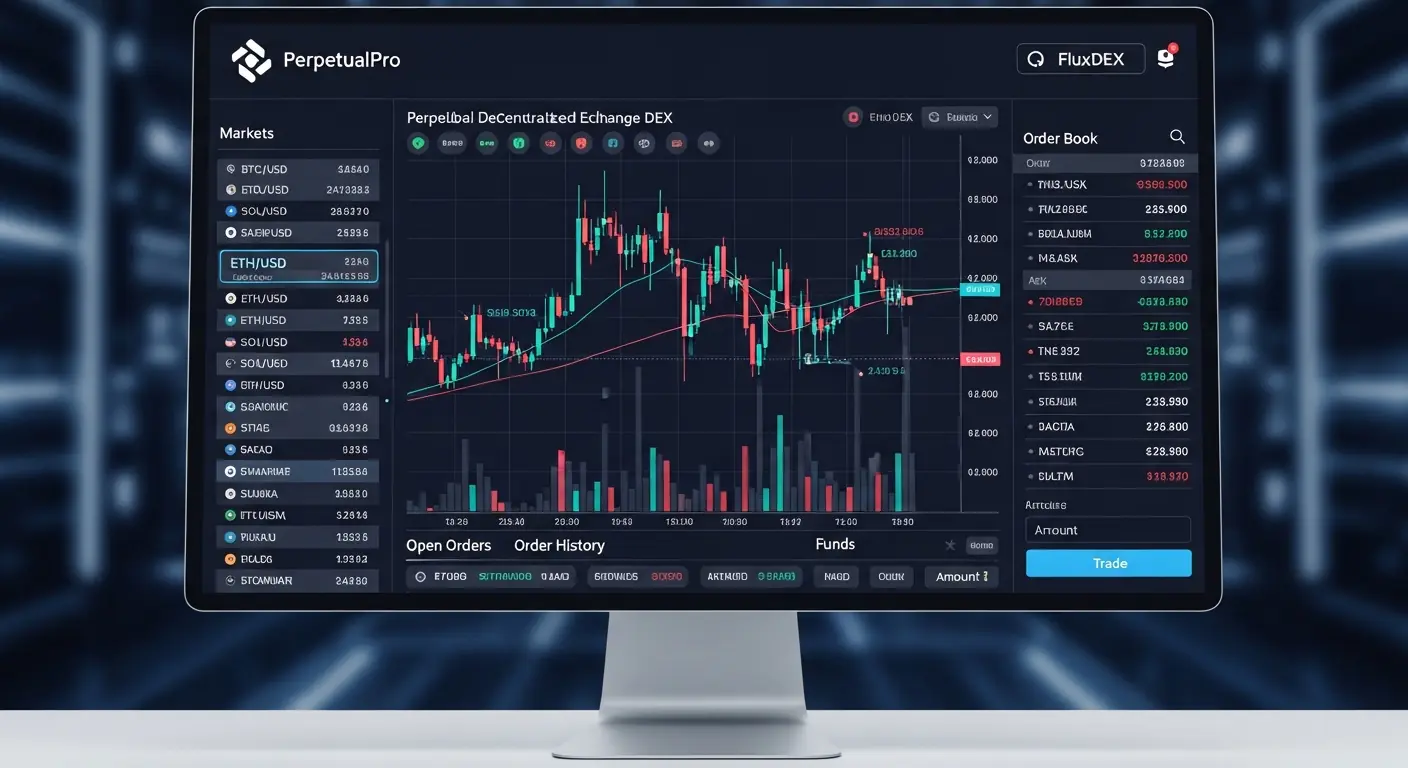
A perpetual DEX is a blockchain-based platform that allows users to trade perpetual futures contracts in a decentralized manner. Unlike traditional exchanges, these platforms rely on smart contracts to manage order execution, collateral, and settlement. One of the defining characteristics of perpetual futures is the absence of an expiry date, which distinguishes them from standard futures contracts that settle at a predetermined time. Instead, perpetual contracts rely on periodic funding payments between long and short traders to maintain price parity with spot markets.
In a decentralized environment, smart contracts automate the entire trading lifecycle. When a trader opens a position, the contract locks collateral and tracks the position’s value in real time. Continuous settlement ensures that profits and losses are reflected instantly, reducing counterparty risk. Traders can take long positions if they expect prices to rise, or short positions if they anticipate declines, with leverage amplifying both potential gains and losses.
The growing adoption of perpetual DEXs is driven by several key advantages. First, they provide permissionless access, allowing anyone with a crypto wallet to participate regardless of geographic location. Second, they eliminate the need for custodians, giving users full control over their assets. Finally, all transactions are recorded on-chain, ensuring transparency and enabling independent verification of platform activity—an essential feature in building long-term trust.
Understanding the Core of Perpetual DEX Platforms
What Is a Perpetual DEX?
A perpetual DEX is a blockchain-based trading platform that allows users to engage in perpetual futures trading without intermediaries. These platforms utilize smart contracts to manage all aspects of trading, including order execution, collateral management, and settlement. Unlike centralized exchanges, where users must deposit funds into custodial accounts, perpetual DEXs enable direct interaction from personal wallets, ensuring greater security and control.
Key Differences Between Perpetual and Traditional Futures
Traditional futures contracts are bound by expiration dates, requiring traders to either settle or roll over their positions at predetermined intervals. In contrast, perpetual futures eliminate this constraint, enabling continuous exposure to market movements. Instead of expiry-based settlement, they rely on funding rates to keep prices aligned with the underlying asset. This mechanism ensures that the perpetual contract closely tracks the spot market, making it more practical for long-term trading strategies.
Funding Rates and Price Anchoring Explained
Funding rates are a core component of perpetual DEXs, acting as a balancing mechanism between long and short traders. When the perpetual price deviates from the spot price, funding payments are exchanged between traders to incentivize correction. For example, if the perpetual price is higher than the spot price, long traders pay short traders, encouraging price convergence. This dynamic system helps maintain market stability without requiring centralized intervention.
How Perpetual Contracts Work in a Decentralized Environment
Smart Contracts as the Execution Engine
In a decentralized environment, smart contracts serve as the backbone of trading operations. They automatically execute trades, manage collateral, and enforce rules without the need for intermediaries. This automation reduces operational risk and ensures that all transactions are executed exactly as programmed, providing a high level of reliability and transparency.
Continuous Settlement and Real-Time Accounting
Perpetual DEXs operate on a continuous settlement model, where profits and losses are calculated and updated in real time. This eliminates the need for periodic settlement cycles and reduces counterparty risk. Traders can monitor their positions dynamically, allowing for more responsive decision-making in fast-moving markets.
Understanding Long and Short Positions
Trading on a perpetual DEX involves taking either long or short positions based on market expectations. A long position benefits from rising prices, while a short position profits from declining prices. The availability of leverage amplifies both gains and losses, making it a powerful but potentially risky tool that requires careful management.
Key Benefits Driving Adoption
Permissionless Access and Global Liquidity
One of the most compelling advantages of perpetual DEXs is their permissionless nature. Anyone with an internet connection and a crypto wallet can access these platforms, removing traditional barriers such as geographic restrictions or account approvals. This global accessibility contributes to deeper liquidity and more efficient markets.
Self-Custody and Reduced Counterparty Risk
Unlike centralized platforms, perpetual DEXs do not require users to relinquish control of their funds. Assets remain in the user’s wallet, significantly reducing the risk of loss due to exchange failures or mismanagement. This self-custody model has become increasingly attractive in light of past incidents involving centralized exchanges.
Transparency Through On-Chain Verifiability
All transactions and operations on a perpetual DEX are recorded on the blockchain, making them publicly accessible and verifiable. This transparency allows users to independently audit platform activity, fostering trust and accountability. It also ensures that trading rules are applied consistently, without the possibility of manipulation or hidden actions.
Market Landscape and Opportunity Analysis
Current Trends in Decentralized Derivatives
The decentralized derivatives market has evolved from a niche segment of DeFi into one of its fastest-growing verticals, driven by increasing demand for leveraged trading and advanced financial instruments. Over the past few years, perpetual DEXs have captured a growing share of on-chain trading volume, with some platforms processing billions of dollars in daily transactions. This growth is fueled by improvements in blockchain scalability, user interfaces, and liquidity provisioning models, making decentralized trading more competitive with centralized alternatives.
User adoption patterns reveal a steady influx of both experienced crypto traders and new entrants seeking greater control over their assets. Retail users have been the primary drivers of early adoption due to the accessibility and permissionless nature of these platforms. However, institutional interest is accelerating as infrastructure matures, particularly with the emergence of Layer 2 scaling solutions and improved compliance frameworks. Institutions are increasingly exploring perpetual DEXs for hedging, arbitrage, and diversification strategies, signaling a shift toward broader market legitimacy.
Gaps in Existing Perpetual DEX Solutions
Despite strong growth, several structural challenges continue to limit the full potential of perpetual DEXs. One of the most significant issues is liquidity fragmentation. With multiple platforms operating across different blockchains, liquidity is often dispersed, resulting in inefficient markets and higher trading costs. Traders may struggle to execute large orders without experiencing significant slippage, which reduces overall platform competitiveness.
User experience remains another critical barrier. Many perpetual DEXs are designed with technically sophisticated users in mind, leading to complex interfaces that can be overwhelming for beginners. Features such as leverage settings, margin requirements, and liquidation risks are not always presented in an intuitive manner, creating friction during onboarding and limiting mass adoption.
Scalability also presents ongoing challenges. High transaction fees and network congestion, particularly on Layer 1 blockchains, can negatively impact trading performance. Delays in order execution and increased costs during periods of high demand reduce the efficiency of decentralized platforms compared to centralized exchanges. While Layer 2 solutions and alternative blockchains are addressing these issues, achieving seamless scalability remains a work in progress.
Identifying Your Competitive Edge
In an increasingly competitive market, differentiation is essential for success. One effective strategy is to target specific user segments. Platforms designed for professional traders may focus on advanced order types, deep liquidity, and high-speed execution, while those targeting beginners may prioritize simplicity, educational tools, and guided trading experiences. Additionally, focusing on niche asset classes—such as synthetic assets, long-tail tokens, or tokenized real-world assets—can help platforms carve out unique market positions.
Technological innovation also plays a key role in establishing a competitive edge. Enhanced matching engines, improved liquidity models, and cross-chain interoperability can significantly improve performance and user experience. Incentive structures, including dynamic fee models and sustainable token rewards, further differentiate platforms by aligning user participation with long-term growth. Ultimately, the most successful perpetual DEXs are those that combine technical excellence with a clear understanding of their target audience.
Architecture of a Perpetual DEX
High-Level System Design
The architecture of a perpetual DEX is a complex interplay between on-chain transparency and off-chain efficiency. Core functionalities such as asset custody, margin management, and settlement are typically handled on-chain through smart contracts to ensure security and trustlessness. However, to achieve the speed required for active trading, many platforms incorporate off-chain components for order matching and data processing. This hybrid approach allows developers to balance decentralization with performance, ensuring a seamless trading experience.
Matching engines are a critical component of this architecture. They determine how buy and sell orders are paired and executed. In fully on-chain systems, matching occurs directly on the blockchain, ensuring transparency but often at the cost of speed and higher fees. Off-chain matching engines, on the other hand, enable faster execution by processing orders externally before settling them on-chain. The choice of execution model has significant implications for latency, cost, and user experience.
Order Book vs AMM-Based Models
Perpetual DEXs primarily rely on two execution models: central limit order books (CLOBs) and automated market makers (AMMs). The CLOB model replicates traditional exchange infrastructure, where orders are matched based on price and time priority. This approach provides precise pricing and is favored by professional traders, but it requires deep liquidity and sophisticated infrastructure to function effectively.
AMMs offer a more decentralized alternative by using mathematical formulas to determine asset prices. Instead of matching buyers and sellers directly, trades are executed against liquidity pools. This model ensures continuous liquidity and simplifies the trading process, making it more accessible to a wider audience. However, AMMs may struggle with capital efficiency and price accuracy during periods of high volatility.
To address these limitations, many platforms are adopting hybrid architectures that combine elements of both models. These systems leverage the efficiency of order books while maintaining the accessibility and liquidity of AMMs, resulting in a more balanced and robust trading environment.
Smart Contract Layers
Smart contracts form the backbone of a perpetual DEX, governing every aspect of the trading process. Core trading contracts are responsible for executing trades, managing user positions, and handling collateral. These contracts must be highly secure and optimized for performance, as they directly impact user funds and platform reliability.
Margin and liquidation modules operate alongside trading contracts to monitor risk levels and enforce collateral requirements. These components automatically trigger liquidations when positions fall below maintenance thresholds, ensuring that the platform remains solvent. Funding rate mechanisms are also embedded within smart contracts, facilitating periodic payments between traders to maintain price alignment with underlying markets.
The modular design of these contract layers allows for flexibility and scalability, enabling developers to upgrade specific components without disrupting the entire system.
Backend Infrastructure
While smart contracts handle on-chain operations, backend infrastructure plays a crucial role in delivering a smooth user experience. Indexers and data pipelines process blockchain data and transform it into usable formats for analytics and visualization. This enables real-time tracking of positions, trades, and market conditions.
APIs serve as the bridge between backend systems and frontend interfaces, allowing users to interact with the platform seamlessly. A well-designed API infrastructure ensures fast data retrieval and efficient communication, which is essential for high-frequency trading environments.
Finally, real-time price feeds and oracle networks are critical for accurate and reliable trading. Oracles aggregate data from multiple sources to provide up-to-date market prices, ensuring fair execution and preventing manipulation. The reliability of these systems directly impacts the integrity of the platform, making them a key focus area in perpetual DEX development.
Liquidity Design and Capital Efficiency
Liquidity Models Explained
Liquidity remains the foundation of any successful perpetual DEX, directly influencing trading efficiency, user retention, and overall platform competitiveness. Unlike centralized exchanges that rely on market makers, decentralized platforms experiment with alternative models such as virtual automated market makers (vAMMs) and liquidity pools. vAMMs simulate deep liquidity through mathematical curves rather than requiring equivalent capital deposits, allowing platforms to support high trading volumes with reduced capital requirements. Meanwhile, liquidity pools and peer-to-peer matching systems distribute risk across participants, often making liquidity providers the counterparty to traders rather than a centralized entity.
These models aim to solve one of DeFi’s most persistent challenges: capital inefficiency. By optimizing how liquidity is allocated and utilized, perpetual DEXs can offer tighter spreads and better execution, even in volatile market conditions. However, achieving this balance requires continuous tuning of pricing algorithms and incentive structures.
Incentivizing Liquidity Providers
To bootstrap and sustain liquidity, perpetual DEXs rely heavily on incentive mechanisms. Liquidity providers are typically rewarded through a combination of trading fees, yield farming opportunities, and token emissions. While these incentives can rapidly attract capital, poorly designed tokenomics may lead to short-term participation and long-term instability. Sustainable platforms focus on aligning incentives with long-term engagement, ensuring that liquidity remains stable even after initial rewards diminish.
Advanced protocols are increasingly introducing dynamic reward systems that adjust based on market conditions, encouraging liquidity provision where it is most needed. This evolution reflects a broader shift toward more sophisticated economic design in DeFi.
Managing Slippage and Market Depth
Efficient liquidity design also plays a crucial role in minimizing slippage—the difference between expected and executed trade prices. High slippage can deter traders, particularly those executing large orders. To address this, perpetual DEXs employ dynamic pricing mechanisms that adjust in real time based on order size and market volatility.
Additionally, risk-adjusted liquidity provisioning is gaining traction as a method to improve capital efficiency. By allocating liquidity based on volatility and demand, platforms can maintain deeper markets while reducing unnecessary capital lock-up. This not only enhances user experience but also contributes to overall market stability.
Risk Management and Liquidation Systems
Margin Frameworks
Risk management is a cornerstone of perpetual DEX functionality, particularly due to the use of leverage. Margin frameworks define how much collateral traders must maintain to open and sustain positions. Initial margin represents the capital required to initiate a trade, while maintenance margin ensures that positions remain adequately funded. If the value of a position falls below the maintenance threshold, it becomes eligible for liquidation.
Platforms typically offer two margin modes: cross margin and isolated margin. Cross margin allows traders to share collateral across multiple positions, maximizing capital efficiency but increasing systemic risk. Isolated margin, on the other hand, limits risk to individual trades, providing greater control for risk-averse users.
Liquidation Engine Design
The liquidation engine is designed to protect both the platform and its users from insolvency. When a trader’s collateral falls below required levels, the system automatically closes or reduces the position to prevent further losses. Modern perpetual DEXs are increasingly adopting partial liquidation strategies, which gradually reduce position size instead of closing it entirely. This approach minimizes market disruption and helps traders retain some capital.
Efficient liquidation systems are critical during periods of high volatility, where rapid price movements can trigger cascading liquidations. By optimizing execution speed and accuracy, platforms can mitigate systemic risks and maintain market integrity.
Insurance Funds and Backstop Mechanisms
To further enhance resilience, many perpetual DEXs maintain insurance funds that act as a financial buffer during extreme market conditions. These funds are used to cover losses when liquidations cannot be executed efficiently, preventing negative balances and protecting the broader ecosystem.
In addition to insurance funds, some platforms implement backstop mechanisms such as socialized losses or liquidity provider interventions. These systems ensure that even in worst-case scenarios, the platform remains solvent and operational. As highlighted in recent analyses, risk factors such as leverage misuse, oracle failures, and sudden volatility spikes make robust risk management essential for long-term success.
The Strategic Importance of Perpetual DEX Development
The rapid growth of perpetual DEXs underscores their strategic importance within the broader financial ecosystem. With daily trading volumes reaching tens of billions of dollars and annual volumes surpassing trillions, these platforms are no longer niche experiments but core components of the crypto economy.
One of the most compelling aspects of perpetual DEXs is their ability to democratize access to advanced financial instruments. By removing intermediaries and enabling global participation, they open up opportunities for traders who were previously excluded from traditional derivatives markets. At the same time, they introduce new challenges, including the need for robust infrastructure, user-friendly interfaces, and comprehensive risk management systems.
For builders, this presents a unique opportunity to shape the future of trading. Innovations in scalability, liquidity design, and user experience will play a निर्ण decisive role in determining which platforms succeed. As institutional interest continues to grow and technology advances, perpetual DEXs are poised to become a dominant force in global finance, bridging the gap between traditional markets and decentralized systems.