
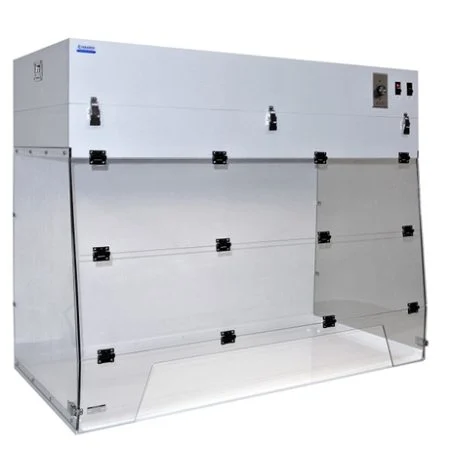
A portable ductless fume hood can give you flexible containment when your laboratory setup requires mobility or when installing permanent exhaust ductwork is impractical. However, you should never treat a ductless hood as a universal solution for every chemical process. Safe operation starts with understanding the chemicals you handle, the hood’s filtration capability, airflow requirements, and the manufacturer’s operating limits.
Confirm That the Hood Is Suitable for Your Application
Before you begin, identify every chemical, vapor, particulate, or process that you plan to use inside the hood. A ductless system relies on filtration to capture contaminants before filtered air returns to the laboratory. Depending on the design, filtration may involve activated carbon, HEPA, or other specialized media.
Do not assume that one filter works for every chemical. Some substances can pass through a filter, rapidly saturate it, or require a specialized filtration method. Review the manufacturer’s chemical compatibility information and your laboratory’s safety procedures before starting work.
For applications requiring a flexible enclosure, explore portable ductless fume hoods for flexible laboratory containment and verify that the selected configuration matches your intended application.
You should also involve your laboratory safety or EHS professional when your facility requires approval for ductless equipment. Some institutions restrict or prohibit portable ductless hoods for certain applications because filtration effectiveness varies by chemical.
Inspect the Hood Before Starting Work
Make a quick inspection part of your routine. Check the enclosure, sash, fan, airflow indicator, filters, electrical connections, and visible seals for signs of damage or abnormal operation.
Turn the hood on before introducing chemicals and verify that the airflow indicator shows normal operation. If your unit has an alarm, make sure it is not displaying a fault condition.
Never continue working if the airflow is inadequate or the hood appears to be malfunctioning. OSHA guidance emphasizes proper hood operation and airflow verification before use.
You should also confirm that the filter has sufficient remaining service life. Do not wait until you notice an odor before replacing a filter. Odor is not a reliable indication that a filter is functioning safely.
Set Up Your Work Area Correctly
Good organization helps maintain stable airflow. Keep equipment and chemical containers away from the hood opening and avoid blocking internal airflow paths or filter areas.
Place the source of contamination as far inside the enclosure as practical. Traditional fume hood guidance commonly recommends working at least six inches inside the hood face to improve containment.
Keep unnecessary items outside the hood. Avoid storing chemicals inside the enclosure because a spill or container failure can rapidly increase the contaminant load on the filtration system.
Do not make rapid movements around the hood opening. Strong drafts, open doors, fans, and frequent movement can disturb airflow and reduce containment effectiveness.
Use Appropriate PPE and Safe Work Practices
A fume hood is an engineering control, not a replacement for personal protective equipment. Select PPE according to the hazards of the specific chemicals and procedure.
You may need chemical-resistant gloves, safety goggles, a laboratory coat, protective clothing, or other specialized PPE. Keep your face and upper body outside the hood opening while contaminants are being generated.
Keep chemical containers closed whenever they are not actively being used. Never use the hood as a chemical storage cabinet or as a place to intentionally evaporate hazardous waste.
You should also avoid processes that exceed the hood’s intended capacity. Heat, pressure, aggressive reactions, highly hazardous substances, and large chemical quantities may require a different engineering control. Some EHS programs specifically prohibit ductless hoods for highly toxic, flammable, explosive, or carcinogenic chemicals.
Monitor Filters and Replace Them on Schedule
Filter management is one of the most important parts of safe ductless hood operation. Unlike a ducted hood that exhausts contaminated air outside the building, a ductless system depends on its filtration system to remove contaminants before returning air to the room.
Follow the manufacturer’s replacement schedule and maintain records of filter changes. Track the chemicals used, operating conditions, and filter status where required by your laboratory SOP.
Do not modify the filter configuration or install an unapproved filter. If the filter becomes saturated, damaged, or incompatible with the chemicals being used, stop the operation and replace or evaluate the filtration system according to your safety procedures.
Know When to Stop Using the Hood
Stop work immediately if an airflow alarm activates, the hood behaves abnormally, the filter indicator signals a problem, or you suspect that contaminants are escaping the enclosure.
Close the sash or access opening when appropriate, secure the process if it can be done safely, and notify the responsible laboratory or safety personnel. Do not attempt to continue an experiment simply because the fan is still running.
For reliable laboratory equipment and application guidance, Global Lab Supply laboratory safety and containment equipment can help you review suitable options for your workspace.
Conclusion
Using a portable ductless fume hood safely requires more than switching on the fan. You need to match the filtration system to your chemicals, inspect the equipment before use, maintain good airflow, minimize clutter, use appropriate PPE, monitor filter condition, and follow your laboratory’s safety procedures.
When your application involves chemicals that exceed the capabilities of a ductless system, choose an appropriate ducted hood or another engineered control instead. If you need help evaluating equipment for your laboratory application, contact us today for laboratory equipment guidance.
Frequently Asked Questions
What is a portable ductless fume hood used for?
A portable ductless fume hood is used to contain and filter certain airborne contaminants generated during laboratory work. Its suitability depends on the chemicals, concentrations, quantities, filtration system, and manufacturer’s approved applications.
Can you use any chemical inside a ductless fume hood?
No. You should only use chemicals that the manufacturer and your laboratory safety procedures identify as compatible with the installed filtration system. Some hazardous chemicals require specialized ventilation or filtration controls.
How often should you replace a ductless fume hood filter?
Filter replacement depends on the filter type, chemicals used, concentration, workload, and manufacturer’s recommendations. You should monitor filter condition and maintain a documented replacement schedule rather than relying on odor.
Should you wear PPE when using a ductless fume hood?
Yes. A fume hood does not replace appropriate PPE. You should select gloves, eye protection, laboratory clothing, and other protective equipment based on the hazards of your specific procedure.
What should you do if the hood airflow alarm activates?
Stop the work, secure the process if it is safe to do so, close the enclosure as appropriate, and notify the responsible laboratory or safety personnel. Do not continue using the hood until its performance has been evaluated.